Free sample questions from the Ontario G1 knowledge test topic "Regulatory signs", each with the answer, an explanation and the handbook section it comes from.
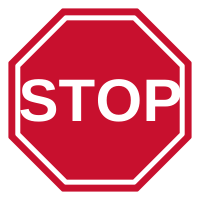
1. What must you do when you see this sign?
Come to a complete stop and go only when the way is clear
Slow down, and roll through without stopping if no other cars are coming
Let oncoming traffic go first without stopping
Stop only if pedestrians are crossing
Answer: A. Come to a complete stop and go only when the way is clear
Explanation: An eight-sided red sign means stop. Come to a complete stop at the stop line, or at the crosswalk, the edge of the sidewalk or the edge of the intersection, and wait until the way is clear.
Source: Official MTO Driver's Handbook · Signs – Stop, school zone, yield and railway crossing signs
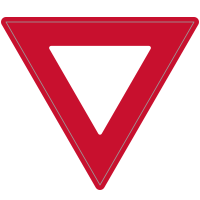
2. What does this sign mean?
A stop sign is ahead; prepare to stop
Do not enter this road
You have the right-of-way, and all other traffic at the intersection must yield to you
Let traffic in or near the intersection go first; stop if necessary
Answer: D. Let traffic in or near the intersection go first; stop if necessary
Explanation: A triangle with a white background and red border means yield: let traffic in the intersection or close to it go first. Stop if necessary and go only when the way is clear.
Source: Official MTO Driver's Handbook · Signs – Stop, school zone, yield and railway crossing signs
3. What does this X-shaped sign mean?
Intersection ahead, where traffic on the cross road has the right-of-way and you must yield
No entry
Railway tracks cross the road: slow down, look both ways for trains, be ready to stop
U-turns are allowed here
Answer: C. Railway tracks cross the road: slow down, look both ways for trains, be ready to stop
Explanation: An X-shaped sign with a white background and red outline marks a railway crossing. Slow down, look both ways for trains and be prepared to stop.
Source: Official MTO Driver's Handbook · Signs – Stop, school zone, yield and railway crossing signs
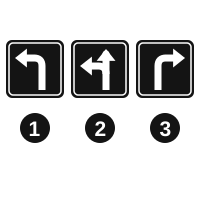
4. What do these lane signs before an intersection mean?
Any lane may go in any direction; the arrows are only suggestions for drivers who are unfamiliar
Lane 1 may not turn left and lane 3 may not turn right
Lane 2 is for U-turns only
Lane 1 must turn left; lane 2 may turn left or go straight; lane 3 must turn right
Answer: D. Lane 1 must turn left; lane 2 may turn left or go straight; lane 3 must turn right
Explanation: On the sign: lane 1 left arrow, lane 2 left-and-straight, lane 3 right arrow. Lane-use signs above the road or on the pavement tell drivers the direction they must travel from each lane.
Source: Official MTO Driver's Handbook · Signs – Regulatory signs
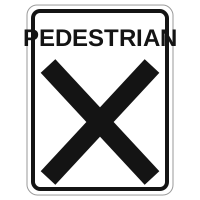
5. What does this sign mean?
A railway crossing is ahead
No pedestrians are allowed on this road, so they must use the underpass
Intersection ahead
A pedestrian crossover: be ready to stop and let pedestrians cross
Answer: D. A pedestrian crossover: be ready to stop and let pedestrians cross
Explanation: On the sign: "PEDESTRIAN" above a large X. This is a pedestrian crossover. Be prepared to stop and yield the right-of-way to pedestrians.
Source: Official MTO Driver's Handbook · Signs – Regulatory signs
This topic has 47 questions in the full bank, which also includes real-format mock tests and a wrong-answer book.